All posts in Out-of-home advertising

What Four Years Has Taught Us: The OOH Industry Doesn’t Need an Expert Tool

When we introduced DOmedia at the OAAA Star Showcase in the fall of 2008, we thought we had a brilliant idea. Thanks to industry feedback, our technology and business model have evolved from an expert tool to a tool for experts! Together we have grown over 300% and we are still the world’s largest OOH media marketplace. Thank you for all the support and feedback that helped us reach this point. DOmedia remains committed to adding value and growing the OOH market by providing incremental business opportunities and working towards an industry-supported path to standardization.

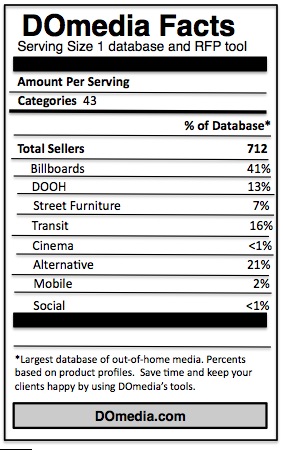
700+ media sellers have posted their assets in the DOmedia marketplace. On the other side of the marketplace, 1,000+ media buyers have used the DOmedia platform to execute 20,000+ plans and searches in the past 12 months. OOH needs tools that integrate with industry relevant data sets. The most efficient way for those integrations to be used by buyers and sellers to create value is to have them hosted on a centralized data resource. A centralized resource will provide seamless end-to-end workflow that will help the industry leap forward and gain a greater percentage of the overall advertising spend. Our strategic partnerships with TelmarNEC, and our participation in industry associations (OAAA, TAB, DPAA, IAB) reaffirm our belief in system integrations. Feedback from those two groups and DOmedia users informs our internal tech development processes and ensures we are building an industry-vetted solution.

DOmedia Vision for OOH

Your feedback has challenged us to address how our technology meets industry needs:

  • Improved search, discovery and planning – Our dynamic search tool is self-directed and can be used at any stage of the RFP process. Media sellers can be found by format, audience measurement type and demographics. Search results can be further filtered by geographic parameters and displayed with data visualization tools.
  • Standardization of the RFP process – We have taken the incremental steps towards standardizing buyer RFP templates and media proposals. Standardized templates allow OOH to be planned and bought on a larger scale similar to other media, which saves significant time for the buyer and seller by removing RFP redundancies.
  • Telmar Integration ‘€“ For the first time, Telmar’s TOPS plans with TAB OOH Ratings data will be able to be converted into an RFP with a single click. The most trusted OOH media measurement is now seamlessly incorporated into the most widely used RFP tool.

With your continued participation in our development efforts, we will increase demand by providing a more compelling value proposition of OOH media’s capabilities. We will keep improving RFP workflow and simplifying the access to data that better informs buyers, planners, and ultimately the brand client. From the use of our technology we are producing meaningful reports that benefit all industry participants.

We welcome and encourage you to share your thoughts on furthering the evolution of DOmedia’s vision for OOH. Let us know if there is anything else we can do to add value for you and your company. You are the industry experts and we are here to help you grow!


Fall is a Season of Changes

Kim RamserFall is my favorite season, mainly because of the new opportunities and changes that arise. For instance’€”the weather changes, football begins, school starts and planning ramps up. Recently, with your feedback, we have implemented many new changes to our site to help you sell more efficiently. We also have many exciting updates coming to our site within the next month or two. We hope these  improvements will give you more opportunities to grow your business.

Making new sales tools

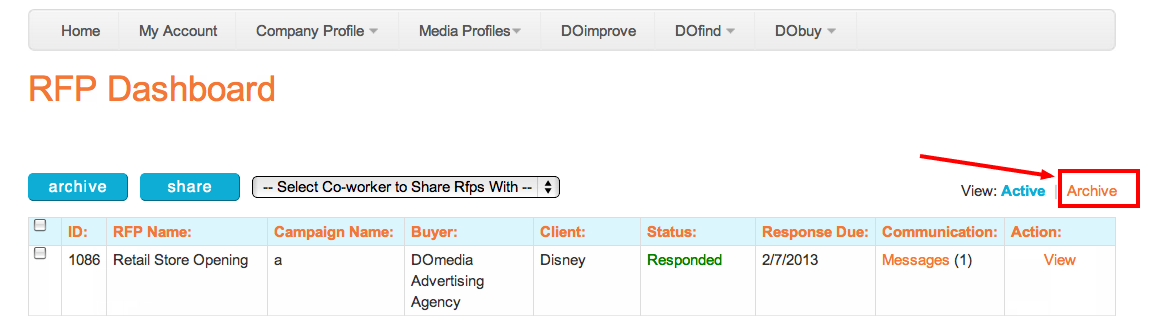
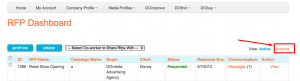
Our developers have been busy refining our RFP Tool by adding enhancements. I hope you have been able to use the Archive button in your RFP Dashboard to make the dashboard easier to view. We hope these tools have made your dashboard easier to keep track of your active RFPs and make it a little easier on the eyes.
Another enhancement we recently added was a ‘€œfix’€ to the downloading of RFP attachments created in the new Microsoft formats’€”(you know, the files with the ‘€˜x’ at the end) for users that prefer Internet Explorer. Hopefully, you have found using these documents much easier than in the past.

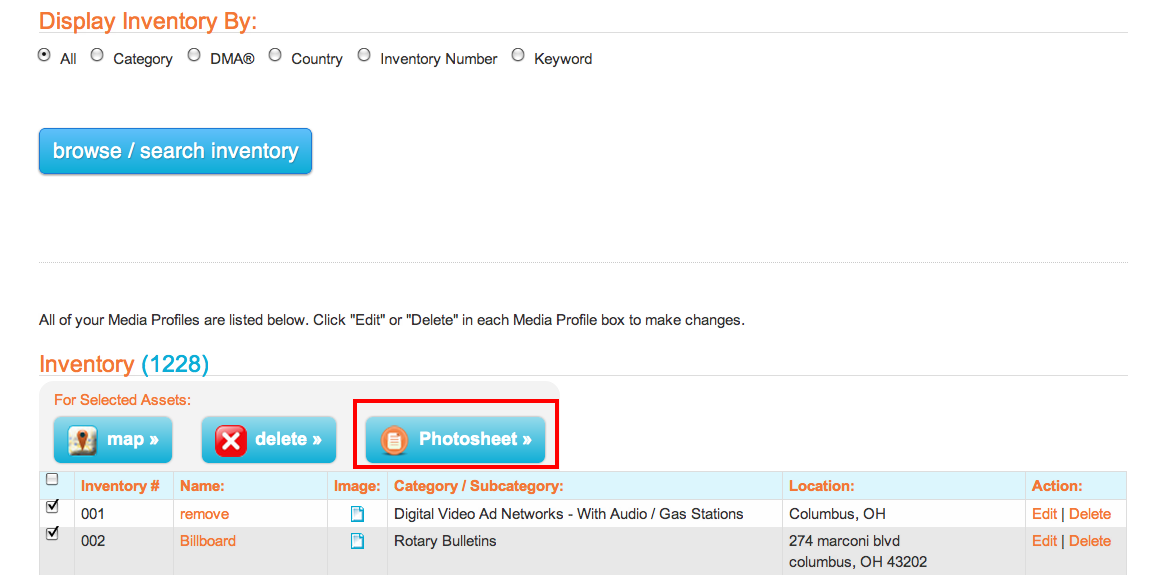
Many of you may have already seen our Create Photosheet button under your Manage My Inventory link. In addition to mapping your inventory, you can now create pdfs of photosheets to send to your clients in one document. Simply select which pieces of inventory you want to propose, then hit the button and save as a pdf. This is a great time-saver for many sellers.  The only caveat is that you have to have your information in the system. You might want to check your current information and add any photos, location data or description information on your products.
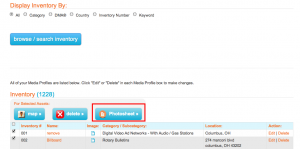
Below is a list of data points included in the photosheets:

  • Contact information (Logo, address and phone)
  • Location image (first picture selected for each location in DOmedia
  • Location geographical Information
  • Cross street description
  • Inventory number
  • Impression data
  • Map image’€”automatically generated from the location data

So, log on and check to see how complete your information is currently, and contact your DOmedia representative to walk you through the upload process.
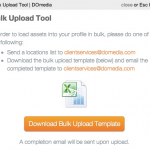
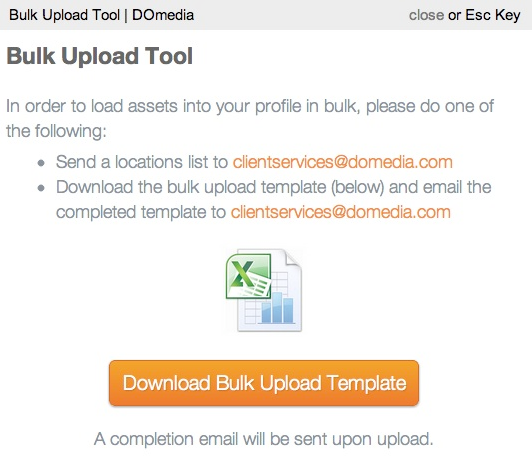
Which brings me to our next enhancement’€”an inventory upload link. Now, you can download a template and populate it with your information for a quick easy upload. It is a great way to upload many pieces of inventory at once without the hassle of uploading each asset at a time.

Soon, we will be adding two new geographic search criteria’€”CBSAs and Counties. We are making it easier for planners and buyers to pinpoint more pertinent areas to bring you more targeted requests. For instance, if you are in 4 of the 7 counties that make up a DMA, then the buyer will have a better idea which counties you are in rather than sending an RFP for the other three counties instead. These enhancements will bring you more applicable opportunities and save you time.
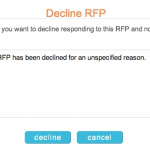
So what happens when you are sold out and don’t have the requested inventory available? Well, we have even made our decline process easier. You no longer have to decline your RFP from the dashboard. You can decline right at the bottom of the RFP Project brief. That makes it easier for you and lets the buyer know right away that you will not be submitting a proposal. Again, saving you time from having to refer back to the dashboard.

Working to make collaboration easier

Our Share button was designed to help you include other team members into your RFP process by giving them access to your RFPs. Many sellers have found this helpful when they are going to be out of the office, or have to collaborate with other offices. Here’s a helpful tip: when you are going to be out of the office for an extended amount of time, let us know. We can make one of your co-workers a default user to ensure that an RFP doesn’t inadvertently fall through the cracks. Then, when you return, just click on your dashboard to see which RFPs have been answered and which ones are still outstanding.
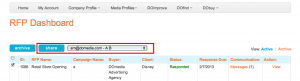
In addition to our share button, we are updating our system in next release to include a print button. You will be able to print your brief to a pdf for emailing, or print it out and give it to the charting or trafficking department. This should save a lot of time making the collaboration part of the process more efficient.

Providing more visibility

We have introduced a strategy access to our agency users. What does this mean to you? It means that we are working hard to recruit planners to our site to give you a better chance of making it into a media plan.  Starting at the beginning, instead of scrambling at the end, is always more effective.

Another improvement that has been added is the additional visibility to research and audience data. Now, when a buyer searches the site, they will automatically know how your audience data is measured. So, if you use ZIP code information for a location, then the buyer will see that designation. Or, if you subscribe to a custom service, like the Traffic Audit Bureau, that label will also be visible in the search results.

If you would like additional information on any of these updates or enhancements, or if you have feedback, please contact us at clientservices@domedia.com.

New Technology, New Ways to Give Back: OOH Reinvigorated

Article by: Kim Ramser, Business Development & Industry Guru, DOmedia

As I wrote in a previous post, out-of-home is often an effective way of improving lives. Outdoor advertising gave back more than $400 million to the communities it served in 2011. But in the current climate of increasing technological innovation, it is important to note that OOH is no longer only billboards, posters, and decals. Out-of-home has found new ways to reach into people’s lives, and in so doing has been able to make changes for the better in health, education, and even bring innovations to the entertainment field.

Digital media companies, such as Monster Media, Amobee, and Massive Media have increased their potential to reach audiences in new, meaningful, and innovative ways, most notably with Projection, NFC and various mobile technologies. Some agencies have incorporated digital software to give the campaign an additional boost. For instance, as I posted in my last blog, BBDO used the Kinect technology, relatively recent software by Xbox that is able to respond to voice commands and body movements.  BBDO revolutionized the Autism Speaks Campaign by using Kinect powered digital billboards. In these ads, the viewer attempts to make eye contact with a digital image of a little girl. However, the billboard can sense the movement of the viewer, and the little girl does not make eye contact’€”a common trait in autistic children’€”no matter how hard the viewer tries. The ad has gotten over 20,000 views on YouTube, and successfully raised awareness for the Campaign.

But Kinect isn’t the only new technology invading the outdoor industry. Pressure sensors are the key component to the efficacy of a series of ads for the French Save Lives Campaign to increase interest in the population for pursuing a career in public health. In this series of ads, a poster is placed inside bus shelters with a photo of a man lying on a hospital bed, while in the top right corner of the photo a mock heart rate monitor flat lines. The viewer is invited to push on his chest, and once he or she complies, the man’s heart rate returns to normal.

A great example of a company using technology to make our lives better is IBM. The Smarter City campaign by Ogilvy, is not a new one, but a great ‘€œperspective’€ campaign. Each time I see it, I am reminded of how technology really can improve our lives. IBM implemented this campaign to raise awareness of the capabilities in they provide in the government space. They showcase smarter solutions globally in public infrastructure. They launched the campaign by creating a virtual ‘€œCity of the Future to serve as product demonstration.’€ They launched www.smartercity.com and promoted their messages through interactive walls and print placements. They also targeted special events like the US Open.  The campaign contained relevant messages to consumers about how they are making their lives better. For instance, in Charleston, SC, they are forecasting crime patterns. These messages tout everything from predicting traffic patterns, and improving healthcare to finding lost luggage more efficiently.

These ingenious advertisements flawlessly and creatively combine new technology with the traditional out of home products. By engaging viewer, new technology enables audiences to actively imagine themselves using a product, participating in an activity or even improving lives in their own communities. DOmedia is happy to have created an easier forum for socially conscious companies to get out their messages to the public, bringing buyers and sellers together in one easy to use forum.

Have you checked out DOmedia‘s newest categories and companies? Search our online database for location-based (QR / NFC / Blue Tooth) technologies, research, social media apps and projection technologies.


Autism Speaks: Kinect Powered Digital Billboards

Digital Buzz, February 19, 2012
http://www.digitalbuzzblog.com/autism-speaks-kinect-powered-digital-billboards/

It has been said, time and again, the out of home industry benefits in creativity, efficiency and awareness by the use of technology. This is evident in this BBDO Autism Speaks campaign. BBDO created a campaign using a Microsoft Kinect powered digital billboard featuring a life size girl who avoids eye contact no matter how hard you try to initiate it.

The Kinect technology tracks the head movements of the person looking into the digital billboard then changes the position the of child’s head and movements to avoid eye contact. The buzz around the campaign created quite a PR boost for this really worthwhile cause, and is even getting some heat on YouTube!


Death of the PDF

The conventional way to package together out-of-home opportunities has long been based on the PDF. PDFs are a great way for a vendor to maintain quality control over what their proposal is to a buyer.  A pattern has emerged where most vendor submissions are a combination of a general media kit, a tailored PDF and a filled-out Excel grid. However simple these current standards seem, they are not able to keep pace with changing needs of the out-of-home industry. Data visualization demands are increasing, and it’s just the beginning. It may seem like a wild claim, but we are dealing with a digital buggy whip here.
Here are three reasons why PDFs will not be used in OOH RFPs within three years:

1. Sending and downloading large files isn’t fun

43% of the attachments vendors upload in the RFP are PDFs (Source: DOmedia Data September 2011 to Present). With the advent of cloud capabilities (Dropbox, Google Docs etc.) sharing and manipulating information in general has gotten easier, which is causing more frustration due to the rigid nature PDFs. Vendors spend time ZIP-ing things together, and buyers spend time un-ZIP-ing. On average, there are 2.4 attachments per OOH RFP (Source: DOmedia Data September 2011 to Present). To address this “give me the kitchen sink and I’ll figure out what works” mentality, DOmedia created a download all button that organizes all the attachments from all the seller for a single RFP.

2. Buyers were not meant to replace the scroll button on their mouse

With an average of 7.7 markets per RFP (Source: DOmedia Data September 2011 to Present), the length of an average PDF can get out of control.  As long as the buyer wants to change absolutely nothing about a proposal, everything things works fine. Unfortunately, that’s very rarely the case. Buyer recommendations often include some level of manipulation of images and location lists before being presented to a client. If the client requires conversion of proposals into a PowerPoint for a pitch, then grab some coffee because it’s going to be a long night…

3. Pretty PDFs ‘‰  Great Client Reports

A common theme in out-of-home is that context matters. While a photo sheet tells the story of an individual location, clients need to see the big picture. Depending on the preference of the planner/buyer and the turnaround time, this ranges from a long menu of options to a very detailed and heavily manually crafted report. Ultimately, to efficiently create reports media buyers collectively must have a unified voice in the way they ask for information from vendors. Fortunately that is what DOmedia allows agencies to do!